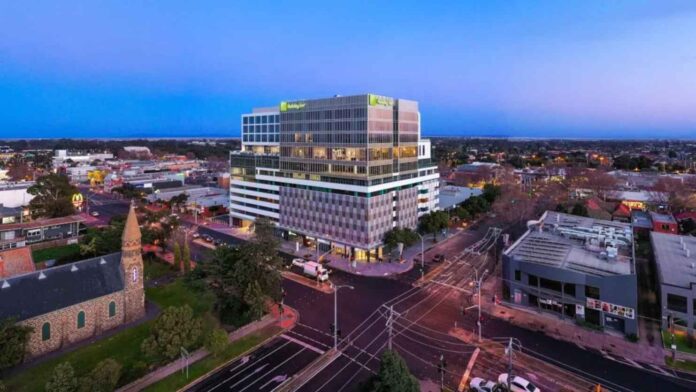
THE $18.2 BILLION SUBURB NOBODY IS TALKING ABOUT: WERRIBEE’S STAGGERING ECONOMIC RISE
There is an old rule in business: go where the growth is. And right now, the growth data for Werribee, Victoria 3030 reads less like a suburban profile and more like a prospectus for one of the most consequential economic transformations in the state.
The numbers, drawn from official government, ABS, CoreLogic and economic modelling sources across 2024 and 2025, tell a story that should be on the desk of every investor, entrepreneur and franchise operator in the country.
This is that story.
THE ECONOMIC FOOTPRINT: $18.2 BILLION AND GROWING
The City of Wyndham — the municipality in which Werribee serves as the administrative and commercial heart — currently generates $18.2 billion in Gross Regional Product, according to the Committee for Wyndham, drawing on National Institute of Economic and Industry Research modelling.
That figure places Wyndham among the most economically significant local government areas in Victoria, accounting for 3.09% of the state’s total Gross State Product.
To put that in context: this is not a dormant outer suburb waiting for something to happen.
Wyndham’s Gross Regional Product was recorded at $16.603 billion for the 2022/23 financial year. In the space of roughly two years, that figure has climbed to $18.2 billion — growth of nearly 10% in an environment of elevated interest rates and subdued national economic momentum.
As recently as the year ending June 2018, Wyndham’s Gross Regional Product stood at $9.44 billion, the economy has effectively nearly doubled in less than a decade.
THE POPULATION ENGINE: 337,009 PEOPLE AND COUNTING
Every economic story is ultimately a people story. Wyndham is one of the fastest growing municipalities in Australia, with a population of 337,009 in 2024.
In the last two years alone, Wyndham experienced a 4% population increase, equivalent to an additional 12,000 residents over that period.
Werribee’s own suburb population grew from 40,345 in 2016 to 50,027 in 2021 — a 24% surge in five years.
The Victorian Government projects the municipality will surpass 500,000 residents by 2041. At that point, Wyndham will be larger than the current populations of Canberra or Newcastle. It will be, in demographic terms, a major Australian city in its own right — with Werribee at its centre.
The dominant household type is couples with children — the highest-spending demographic in retail, hospitality, healthcare, education and household services.
The median age in Werribee is 35, the average wage sits at approximately $86,000 per year, and the median total household income is $1,645 per week. These are not poverty-line statistics.
THE BUSINESS LANDSCAPE: 34,900 REGISTERED OPERATORS, ONE VERY CLEAR OPPORTUNITY
Wyndham is currently home to 34,900 businesses and 114,700 local workers. The city centre precinct alone hosts more than 400 businesses across retail, commercial, dining and professional services categories.
But the ratio that matters most for anyone assessing the commercial opportunity is employment self-containment.
Only 39% of Wyndham’s working residents are employed within the municipality. The remaining 61% commute out — which means their lunchtime spending, their after-work dining, their professional services fees and their discretionary retail dollars are largely leaving the suburb every day.
Wyndham City’s own Economic Development Strategy sets a target of lifting self-containment to 51% by 2040. Close that gap by even half, and the scale of redirected local spending becomes one of the most compelling commercial tailwinds in the Victorian market.
THE INFRASTRUCTURE BET: $148 MILLION IN A SINGLE FINANCIAL YEAR
If population and GRP growth represent the commercial opportunity, capital investment represents the structural confidence of government in that opportunity.
The figures here are remarkable. During 2024/25 alone, Wyndham City delivered $148.2 million worth of capital works, including $29 million on roads, $68.3 million on recreational, leisure and community facilities, $5 million on footpaths and cycleways and $14.9 million on parks, open spaces and streetscapes.
That followed a 2023/24 program in which $145 million in capital works was delivered, including $28.95 million on roads, $66.5 million on recreational, leisure and community facilities, $5.76 million on footpaths and shared paths and $17.9 million on parks, open spaces and streetscapes.
Combined, that is nearly $300 million in local government capital investment in just two financial years.
Victorian and Federal Government co-contributions add further to this figure, with state funding including $4.75 million towards the Jamieson Way Community Centre expansion and $3 million for the Wyndham Cultural Centre upgrade.
Additional allocations include $1.5 million for the K Road Cliffs project and $1.5 million towards the Lawrie Emmins Youth and Gateway Precinct.
The flagship infrastructure initiative is the Connecting Wyndham roads program, which has been nationally recognised with the Institute of Transportation Engineers Sustainable Transport Award.
Among its 2025 completions: a comprehensive $8.5 million upgrade of Old Melbourne Road, Rothwell Road and McLeans Road in Little River, and the transformation of Werribee South’s K Road Cliffs
Infrastructure at this scale and consistency does not happen speculatively. It happens when government bodies have high-confidence projections about where population is going.
The investment pattern in Wyndham is one of the most unambiguous signals available to any commercial operator assessing a location decision.
THE EAST WERRIBEE PRECINCT: 58,000 JOBS, $95 MILLION IN HEALTH ALREADY COMMITTED
The single most significant commercial story in the 3030 postcode is one that many outside the western corridor have not yet registered: the East Werribee National Employment and Innovation Cluster.
Spanning 775 hectares of predominantly greenfield land, the precinct is designated by the Victorian Government as one of only seven national employment and innovation clusters in the state — a priority classification that unlocks accelerated planning processes and targeted investment facilitation.
The projected employment yield is over 58,000 jobs across health, education, research, professional and technical services, and advanced manufacturing.
The anchor health investment has already landed: St Vincent’s Health has committed $95 million to a new 112-bed private hospital and 80-bed aged care facility, employing approximately 350 full-time staff on opening.
Alongside health, the precinct hosts Victoria University, the University of Melbourne, the University of Notre Dame and TAFE campuses.
Multiple tertiary institutions within a single precinct creates what economists call an agglomeration effect — the clustering of talent, research, industry partnership and graduate employment that generates commercial ecosystems well beyond the institutions themselves.
THE INNOVATION ECONOMY: SPARK, AI AND THE STARTUP PIPELINE
The narrative of Werribee as a purely residential-commercial suburb has been formally disrupted by the emergence of SPARK — Wyndham City’s Business and Innovation Hub, located within the East Werribee precinct at 600 Sneydes Road.
The hub offers 40 ergonomic workstations, private offices and meeting rooms for a membership cohort that spans software development, robotics, data analytics, virtual and augmented reality, and professional services. Private offices start from $600 per month inclusive of amenities.
In 2025, Wyndham City and RMIT University partnered to deliver an AI for Business program at SPARK — a practical, structured capability-building initiative aimed at equipping local operators with the analytical and operational tools of the digital economy.
That kind of institutional partnership, where a council collaborates with one of Australia’s leading universities to upskill its business community, is more commonly associated with inner-city innovation precincts than outer suburban growth corridors.
THE PROPERTY MARKET: YIELD, AFFORDABILITY AND THE INVESTOR CASE
For those with a commercial property interest, the Werribee market data from late 2025 presents a genuinely attractive profile.
The median house price in Werribee currently sits at $640,000, with annual capital growth of 4.66% for houses and 5.82% for units. Rental yields are 3.80% for houses and 4.89% for units, with a median weekly rent of $460 for houses and $425 for units.
There were 1,095 house sales and 202 unit sales in the 12 months to November 2025.
At $640,000, Werribee’s median house price sits well below Melbourne’s overall median dwelling value of approximately $772,561 as of February 2025. That affordability gap — roughly $132,000 below the Melbourne median — is a structural driver of demand.
It is why Werribee continues to attract first-home buyers, interstate migrants and investors who have been priced out of Melbourne’s middle ring. And it is precisely the kind of sustained buyer demand that sustains rental markets, services businesses and consumer spending.
The commercial leasing picture tracks the same fundamentals. A suburb with a growing population, a rising income base and significant employer infrastructure under construction is one in which commercial rents are likely to move in one direction over the medium term.
THE TOURISM MULTIPLIER: 1.3 MILLION VISITORS AND AN ELEPHANT ANNOUNCEMENT
Retail and hospitality operators frequently overlook what tourism contributes to a suburb’s commercial energy. In Werribee’s case, that would be a costly oversight.
The Werribee Park Tourism Precinct draws more than 1.3 million visitors per year across Werribee Open Range Zoo, Werribee Mansion, the National Equestrian Centre, the Victorian State Rose Garden and Point Cook Coastal Park.
One point three million visitors is not a rounding error — it is a sustained, year-round source of spending that feeds directly into accommodation, dining, petrol, retail and discretionary services.
And the precinct’s drawcard just got significantly more compelling. Werribee Open Range Zoo has welcomed a nine-strong herd of Asian elephants relocated from Melbourne Zoo.
Three of those elephants — Num-Oi, Dokkoon and Mali — are confirmed pregnant, with calves expected around April 2027. The impending birth of elephant calves at a major Australian zoo is one of the most reliably high-profile wildlife tourism events the country generates.
The media saturation alone will drive visitation curves well beyond current benchmarks. Hospitality operators, accommodation providers and food and beverage businesses within reach of the precinct have a measurable and dateable commercial event to plan around.
THE HONEST NUMBERS: CHALLENGES THAT BELONG IN THE ANALYSIS
Intellectual rigour demands that the pressures receive the same airtime as the opportunities. GDP growth slowed to approximately 1.2% in 2024, impacted by slower global growth and rising interest rates, though growth is anticipated to return to around 2.2% by 2025.
Businesses across Australia are operating in an environment of elevated operating costs, subdued consumer sentiment and labour shortages — pressures that Werribee shares with every other market.
The self-containment figure of 39% is the suburb’s most significant structural commercial challenge.
A business model that depends on capturing the full local consumer base will encounter a market where a majority of working residents are, for now, spending significant portions of their income elsewhere.
The long-term trajectory is clearly toward greater self-containment — the employment precinct investments make that structurally inevitable — but the timeline matters to any operator constructing a short-term business case.
Economic Outlook & Growth (2026)
- Economic outlook: Improving demand for small businesses supported by population growth, though high interest rates and tight labour markets remain key challenges.
- Population forecast: The City of Wyndham is forecast to reach 342,221 people in 2026.
- Employment: The Wyndham economy supports about 91,224 jobs (leading into 2026), representing 27.1% of jobs in Melbourne’s West.
- High-growth sectors: Top sectors for output include real estate services, construction, and agriculture; top sectors for employment include construction, healthcare, and logistics.
- Targeted growth: The East Werribee Employment Precinct is a priority project aimed at delivering 60,000 new jobs.
Werribee City Centre (2026)
- Economic impact: The Werribee City Centre supports around 4,520 jobs and generates about $1.15 billion in annual economic output.
- Revitalisation: A refreshed City Centre Plan adopted in August 2024 expanded the boundary to include Werribee Racecourse and Eagle Stadium to help boost trade and tourism.
Real Estate & Market Data (2025–26)
- Median house price: $650,000–$658,000
- Median unit/townhouse price: $458,000–$462,000
- Median weekly rent (house): $463–$530
- Days on market (houses): 28–31 days
Local Business Initiatives & Support (2025–26)
- AI for business: A local AI training program for businesses delivered via the SPARK Business & Innovation Hub in Werribee in partnership with RMIT.
- WYNnovation 2026: A business expo featuring pitch competitions and workshops to support local innovation.
- Tourism impact: Tourism contributes over $431 million in value-added to the local economy
Every one of those figures comes from a named, verifiable source. None of them are projections dressed up as present reality. They describe, with the cold precision of official data, a suburb that has already arrived — and is still accelerating.
The only credible question for any business-minded reader is not whether Werribee represents an opportunity. It plainly does. The question is whether you are moving fast enough to be there before the market prices that opportunity in.