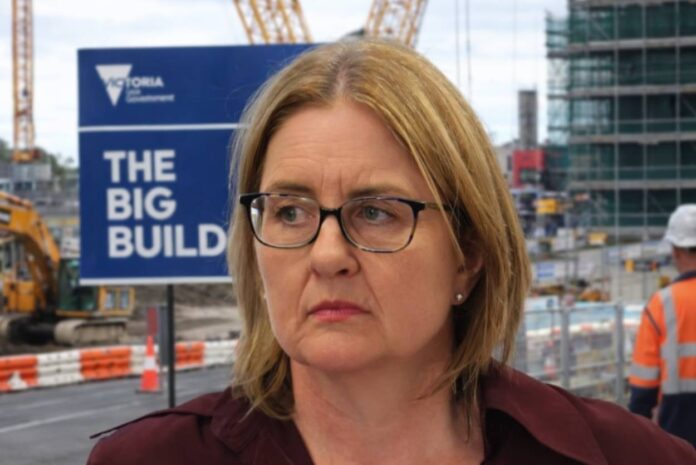
VICTORIA’S $15 BILLION CORRUPTION BOMBSHELL PUTS ALLAN GOVERNMENT IN CRISIS AHEAD OF STATE ELECTION
Victorian Premier Jacinta Allan is facing renewed political heat after explosive claims about corruption on major construction sites reignited debate over the state’s Big Build spending and the government’s oversight of the building industry.
A damning report has alleged that organised crime hollowed out Victoria’s flagship infrastructure program for more than a decade — and that the government knew and did nothing. With an election looming and a state drowning in debt, Jacinta Allan is fighting for her political life.
By the time Victorian Premier Jacinta Allan finally fronted the cameras last week, the damage was already done.
Her Attorney-General, Sonya Kilkenny, had spent the morning fielding questions the Premier should have been answering herself — questions about what the government knew, when it knew it, and why, by all available evidence, it chose to look away.
The trigger was a 136-page report by anti-corruption barrister Geoffrey Watson SC, commissioned to examine the conduct of the Construction, Forestry, Maritime, Mining and Energy Union (CFMEU) in Victoria.
The findings, tendered to Queensland’s Commission of Inquiry into misconduct in the construction industry, are extraordinary in their scope and severity.
“The Setka-led Victorian branch of the CFMEU was no longer a trade union,” Watson wrote. “It was a crime syndicate.”
The alleged scale is staggering: Watson estimated corruption and unlawful conduct added about 15% to infrastructure project costs — a figure he described as “probably conservative”.
On that basis, he concluded CFMEU-linked corruption may have cost Victorian taxpayers around $15 billion across the state’s vast infrastructure pipeline.
To put that figure in human terms, it is roughly equivalent to more than $5,000 per Victorian household and rivals the combined annual budgets of the state’s police and health systems.
“Much of that $15 billion has been poured directly into the hands of criminals and organised crime gangs,” Watson wrote.
What made the story incendiary was not just what the report said — it was what had been removed from it.
Pages perceived to be highly damaging to the Victorian Labor government were initially redacted at the request of CFMEU administrator Mark Irving KC before the full text was unearthed and published by the Queensland commission.
The deleted sections were blunt. One removed chapter alleged the Victorian government was aware of CFMEU misconduct but chose to turn a blind eye, stating: “There is no doubt the government knew about the rising problem — but it is equally clear that the government did nothing.”
Watson told the inquiry he had “ample evidence” to support both the financial estimate and his concerns about government inaction, but had been directed to remove those sections.
Asked why he believed the Victorian government had been intimidated, Watson was direct: “The CFMEU had built up such momentum of authority and power that everybody was scared of them.”
The report’s portrait of life on Big Build worksites is deeply disturbing. Major construction sites allegedly became drug distribution hubs run by outlaw motorcycle gangs, with bikie groups fighting each other for territorial control of individual projects.
Redacted sections claim officials monitored the blowouts yet “did nothing,” intimidated by the CFMEU’s power.
The report also found that a professional hit was planned on CFMEU administrator Mark Irving after he took control of the union, and that underworld figure Mick Gatto made “tens of millions of dollars” through his dealings with the CFMEU.
All of the claims remain allegations and have not been tested in court.
Allan’s Own Fingerprints
The political problem for Jacinta Allan is not merely that these things allegedly happened. It’s alleged that she was there.
The findings directly contradict longstanding denials by Allan, who has said she was unaware of corruption concerns until media investigations exposed the issue in 2024.
Yet as Minister for Transport Infrastructure during the height of John Setka’s reign, Allan oversaw the very projects now at the centre of the scandal.
A referral letter she wrote to IBAC dated July 14, 2024 — released publicly only in February 2026 following media pressure — outlined alarming allegations.
They included claims that a CFMEU health and safety official misused a government vehicle for bikie gang activities, that an individual drove to Footscray Hospital with a gunshot wound in a state-funded car, and that CFMEU officials advised contractors to hire subcontractors controlled by organised crime.
Yet despite that letter, Allan has firmly rejected calls for a royal commission. She described the $15 billion figure as “unsubstantiated” and the specific allegations against her government as not “well-tested or properly founded.” She did not commit to personally referring the allegations to IBAC.
When the matter was referred to IBAC, the watchdog responded that it did not have the “follow the money” power to investigate private subcontracting activity within the Big Build program. The result: no independent inquiry with compulsive powers has yet been established.
Opposition Leader Jess Wilson was unsparing. Allan, she said, was “utterly compromised” and had turned a “blind eye.” Wilson and Shadow Attorney-General James Newbury have labelled the scandal the state’s worst corruption case, calling for a full Royal Commission.
Allegations of bikies, strip clubs and drugs within the CFMEU intensify pressure on Allan’s premiership
It’s also been alleged that over two decades the Victorian branch morphed from a trade union into a “crime syndicate”, with government sites operating as “drug distribution centres”, strippers performing on night shift and bribes and extortion commonplace.
The report was commissioned by the CFMEU’s administrator, who was appointed by the federal government to take over the construction arm in mid-2024, after a media investigation which alleged bikies and underworld figures had infiltrated government projects.
Allan defends Labor’s handling of CFMEU corruption scandal
Jacinta Allan has long resisted any real political reckoning over the glaring failures of her government — from Victoria’s surging debt to rising crime.
Even so, it takes remarkable gall for the Premier to dismiss the enormous cost of failing to curb — or even properly acknowledge — clear evidence of criminal activity flourishing in the state’s construction industry for years.
Instead, Allan dismisses the damning findings of Geoffrey Watson, SC, the barrister tasked with investigating the issue by the federal administrator of the CFMEU. Her strategy is to attack anyone, including the media, for citing Watson’s findings or querying why Labor allowed such destructive corruption and criminality to proceed unimpeded.
“To repeat unfounded claims is reckless,” she insisted in yet another combative press conference last week.
Allan’s extreme sensitivity likely reflects the fact that, before succeeding Daniel Andrews, she served as Victoria’s infrastructure minister.
A State Drowning in Debt
The corruption allegations land in a state already under severe fiscal strain. Victoria’s net debt is projected to reach $187 billion by 2028, with a credit rating already downgraded to AA — the lowest of any Australian state.
State debt has grown by 415% since 2014, while the economy expanded by just 29%. As of mid-2025, Victoria’s net debt stood at $150.9 billion, and is projected to reach $177.8 billion by mid-2027 — some $6.4 billion higher than predicted just six months prior.
The infrastructure projects intended to justify that debt have themselves become symbols of fiscal dysfunction.
The Metro Rail Tunnel added $837 million in cost overruns to reach $13.48 billion, while the West Gate Tunnel arrived three years late and $4 billion over budget.
The North East Link has blown out by more than $10 billion to $26.1 billion. The Suburban Rail Loop, the government’s signature long-term project, carries a projected total cost exceeding $200 billion — roughly four times its initially announced price.
These are not abstract accounting failures. They represent real choices, real oversight, and real accountability — or the lack of it.
A Political Ledger Already Full
The CFMEU crisis arrives atop a political record that already carries significant weight.
Allan served as the minister responsible for Victoria’s ill-fated hosting of the 2026 Commonwealth Games.
The event was cancelled in July 2023 after projected costs surged from an initial $2.6 billion to more than $6 billion — a humiliating reversal that cost taxpayers at least $589 million in withdrawal penalties and left regional venues half-built. Critics have never let her forget it.
She was also a senior cabinet minister through the Andrews government’s management of the COVID-19 pandemic, when Melbourne endured some of the world’s most prolonged lockdowns and sweeping vaccine mandates.
Those policies remain contested — defended by public health advocates, but deeply resented by many Victorians who argue the economic and psychological costs have never been fully accounted for.
And in recent weeks, her clashes with journalists — terse, defensive exchanges that have been replayed extensively — have reinforced a perception among critics that the government has chosen self-protection over transparency.
The Question Inside Labor
Within Victorian Labor, conversations are taking place that no one wants to put on the record. Allan retains genuine support: she is regarded by many in the movement as a principled progressive, a champion of multicultural Victoria and LGBTQIA+ rights, with bedrock support from key Labor constituencies.
But support and electability are different things. With the state election due on 28 November, the pressure is no longer theoretical.
Polling is tightening. The opposition has a defined narrative — financial mismanagement, union corruption, and a premier who looked the other way — and it is landing.
The question confronting Labor is whether the party can sell a positive vision for the future of Victoria while the government’s past is being excavated in a Queensland commission room, page by damning page.
For now, Jacinta Allan insists she is staying, fighting, and governing. She has expressed zero tolerance for union corruption and pointed to Operation Hawk — a dedicated Victoria Police unit established in July 2024 — as evidence of her government’s resolve.
Police have made arrests of key figures, an important step, but investigators lack the powers to conduct the kind of broad-based inquiry that a Royal Commission would enable.
Whether that argument persuades Victorians — or even her own caucus — between now and November may be the central political question of the year.
The Watson report has been referred to the Australian Federal Police, Victoria Police, the Fair Work Commission and other relevant authorities. None of the allegations have been determined by a court.