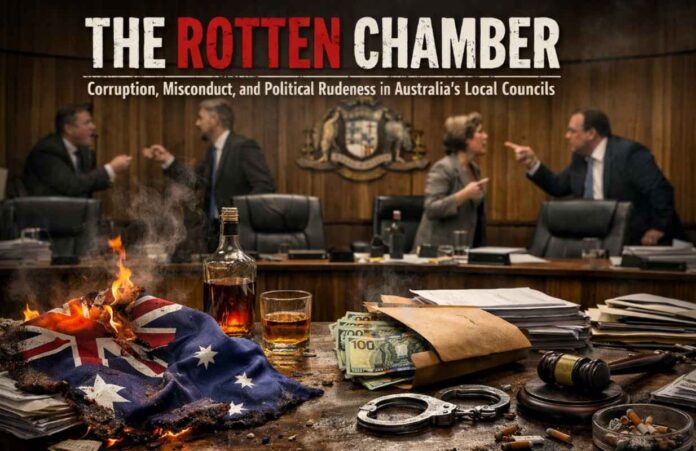
The corruption, bullying, and secret deals quietly rotting Australia’s town halls and Local Councils from the inside out.
It starts the same way every time.
A developer needs a rezoning. A councillor needs a campaign. Somebody makes an introduction. Somebody picks up the tab at dinner.
Nobody writes it down. A few months later, a vote goes the right way, land values jump by millions, and the community that was supposed to benefit from proper planning is left with a subdivision nobody needed and a council chamber full of people who have quietly become very comfortable.
This is not a conspiracy theory. It is a pattern — documented in thousands of pages of evidence gathered over decades by anti-corruption watchdogs across this country.
It is happening, as you read this, in suburbs and shires and regional centres from Cairns to Cranbourne. And in most cases, nobody is watching.
Australia operates 537 local councils. They control planning decisions worth billions. They manage public spaces, roads, community services, and local infrastructure.
They collect your rates and decide how to spend them. And they do all of this with oversight mechanisms that the politicians responsible for running them have, in some states, described as “fundamentally broken.”
That was not the words of a critic. That was NSW Minister for Local Government Ron Hoenig, speaking in late 2024, about the system he is in charge of.
HOW CLEAN IS AUSTRALIA, REALLY?
Not as clean as we think.
In 2012, Australia sat seventh in the world on Transparency International’s annual Corruption Perceptions Index, scoring 85 out of 100. That score made us one of the most trusted governments on earth — a badge we wore with quiet pride.
Over the next nine years, we lost 12 points.
By 2021, we were down to 73 — one of the steepest declines of any country measured. Transparency International did not mince words.
The organisation pointed to “systemic failings in tackling public sector corruption” and noted that Australia was sliding while comparable democracies were either holding steady or improving.
We have climbed back slightly. The 2024 CPI has Australia at 77 points and ranked 10th — partly propped up by the July 2023 creation of the National Anti-Corruption Commission (NACC).
In its first seven months of full operation, the NACC received 1,444 referrals and had 31 active investigations running as of early 2025.
But the NACC only covers federal government. Everything below it — state agencies, local councils, the everyday machinery of governance that affects most Australians most of the time — remains the job of state-based watchdogs.
And what those watchdogs keep finding, when they bother to look, is an integrity crisis hiding in plain sight.
A 2023 Australian Institute of Criminology survey of 11,304 Australians found that a sizeable minority believed more than half of all politicians and government institutions were corrupt.
The people who trusted the system least were the same people most dependent on it — young Australians, unemployed Australians, First Nations Australians, and people living in communities that need functional local government the most.
THE DEAL THAT DEFINED AN ERA: OPERATION SANDON
If you want to understand how badly Australian local government can fail, you start in Casey.
Casey is a sprawling, fast-developing outer-suburban municipality on Melbourne’s south-east fringe — a place of new estates, growing families, and enormous amounts of money moving through the planning system.
It is exactly the kind of environment where the relationship between property developers and elected councillors becomes most dangerous.
In November 2017, Victoria’s Independent Broad-based Anti-corruption Commission — IBAC — quietly opened an investigation. What unfolded over the next five years became the most consequential local government corruption inquiry in Australian history.
Operation Sandon ultimately found that two Casey councillors, Sam Aziz and Geoff Ablett, accepted more than $1.15 million in payments and in-kind support — cash, campaign funding, international travel, other benefits — in exchange for promoting the interests of property developer John Woodman and his clients.
They repeatedly voted on planning matters without declaring any conflict of interest. The investigation found that major planning amendments were being quietly moved through council and up to state-level decision-makers for approval, sometimes without any legitimate strategic rationale whatsoever.
Woodman had operated his network for over a decade — making payments, funding campaigns, courting councillors, building relationships with state MPs — before a single investigator turned up. When IBAC finally held public hearings, the inquiry spanned 40 days. Forty days.
The Victorian Government sacked the entire Casey Council in February 2020 and installed administrators. Casey residents paid their rates for nearly five years without a single elected representative. A new council was finally elected in October 2024.
IBAC tabled its special report in Parliament in July 2023. Its 34 recommendations included stripping some planning decisions from councillors’ hands entirely — a proposal that says everything about how compromised the system had become.
But the human cost of Operation Sandon did not appear in a table of statistics. Former Casey mayor Amanda Stapledon died by suicide in 2022 after receiving a draft of IBAC’s adverse findings. She was later confirmed to have faced no prosecution risk and was not named adversely in the final report.
As of mid-2025, criminal charges have finally been laid. A former Casey councillor faces five offences including receiving secret commissions and misconduct in public office.
A property consultant faces charges for the other side of those same transactions. Both matters are expected before Melbourne Magistrates’ Court in September 2025.
THREE COUNCILS. TEN MONTHS. ALL SACKED.
Casey was not an aberration. It was a pattern.
Between June 2019 and March 2020 — a period of less than ten months — the Victorian Government was forced to sack three separate local councils.
South Gippsland Shire Council went first, in June 2019, after six councillors resigned and governance effectively stopped functioning. Casey followed in February 2020.
Then came Whittlesea — a northern Melbourne council that had burned through five CEOs in five years, not because the job was difficult, but because councillors had made it that way.
The Australian Services Union described Whittlesea as a “very toxic workplace culture,” the polite version of evidence showing elected members systematically intimidating and bullying the people who worked for them.
Three years later, Moira Shire Council — a rural council in northern Victoria — was sacked in March 2023 and handed to administrators until 2028.
A Commission of Inquiry had found governance in collapse, code of conduct breaches, a CEO under investigation, and a staff survey from 2022 in which only 36 per cent of respondents said they felt safe at work.
Read that again. Thirty-six per cent of council staff felt safe at work. The rest did not.
THE CHAMBER: WHERE IT GETS PERSONAL
Corruption makes headlines. Bullying and misconduct — quieter, more insidious, harder to prove — mostly doesn’t.
But the data exists, and it is disturbing.
The Victorian Local Governance Association’s Councillor Census found that more than 60% of female councillors reported experiencing threatening or intimidating behaviour from colleagues inside their own chambers.
Nearly 80% of women councillors said they believed existing processes for dealing with that behaviour were not working.
These are not new recruits struggling to find their feet. These are elected representatives, with a democratic mandate from their communities, telling researchers that the environment in which they are expected to serve is threatening and that nothing is being done about it.
IBAC’s 2024 Perceptions of Corruption survey — drawn from 2,260 local government employees across all 79 Victorian councils — found that breach of professional boundaries, favouritism, nepotism, and deliberate inaction in the face of wrongdoing were the most commonly observed forms of misconduct.
Only 47% of local government employees believed their organisation had a strong ethical culture. Among staff in regulatory roles — the people dealing with planning applications, building permits, environmental enforcement — the figure was even lower.
IBAC specifically flagged, with what reads as barely concealed alarm, a pattern of councillors attempting to “influence, bypass or belittle council staff” as a matter of routine.
And then there is this: a workplace consultancy report found that more than one in four local government workers and councillors had experienced workplace sexual harassment in the past year. More than one in four. In a sector that likes to talk about community values.
In NSW, the Office of Local Government received 1,242 complaints about councils in 2023–24, across 112 separate councils — up from 1,143 the year before. Forty of those complaints concerned misconduct by individual councillors.
Thirty-two involved alleged breaches of pecuniary interest rules — the laws that are supposed to stop councillors from voting on matters where they stand to personally benefit.
This is the system that Minister Hoenig called “fundamentally broken.”
His specific concern: that the complaints mechanism had become a political weapon, with councils drowning in “tit-for-tat” complaints that diverted staff time and ratepayer money from actual governance, while genuine misconduct continued unchallenged underneath.
THE DEVELOPER. THE DONATION. THE DECISION.
Australia has a property problem. Everyone knows it. What fewer people connect is how directly that property problem flows through local government — through the councillors who sit on planning panels, vote on rezoning applications, and shape decisions worth tens or hundreds of millions of dollars.
IBAC has identified the developer-councillor planning nexus as the single highest-priority corruption risk in Victorian local government. The mechanism is not complex.
A developer needs land rezoned. The decision sits with the council. The councillor needs campaign funds, or has a business interest, or has been introduced to the developer at a fundraiser, or has quietly received something that was never disclosed. The vote goes the right way.
Nobody writes anything down. Nothing gets declared. The planning amendment goes through. The land value doubles.
Operation Sandon showed, in forensic detail, how this can operate at industrial scale over many years.
John Woodman’s network of influence — spanning payments, campaign donations, international travel, event sponsorships, and personal relationships — ran through Casey Council for more than a decade. Forty days of public hearings, and IBAC was still finding threads to pull.
The watchdog’s 34 recommendations included reforms to how donations are disclosed, how lobbying must be registered, and — most telling of all — whether planning decisions of a certain type should be removed from councillors’ hands entirely.
When the anti-corruption body recommends taking a decision away from elected representatives because those representatives cannot be trusted with it, you are looking at a structural failure, not just individual bad actors.
THE ACCOUNTABILITY GAP: SLOW, COSTLY, AND REACTIVE
Here is the problem at the centre of all of this: the systems built to catch and punish misconduct are not working fast enough, consistently enough, or with enough consequence to change behaviour.
IBAC receives approximately 11% of all its allegations from local government — but only a fraction meet the threshold required to trigger a full investigation.
Its own research shows that while local government employees broadly trust IBAC as an institution, confidence in its ability to actually detect and prevent corruption at the council level is significantly lower. Many workers are not even sure how to use the system.
In NSW, the OLG received 40 councillor misconduct complaints in 2023–24. It conducted three investigations. Three.
In Moreland — now Merri-bek — a Labor councillor resigned in February 2022 after being charged with conspiracy to cheat and defraud for allegedly tampering with council elections. Democracy, interfered with, inside a council that was supposed to represent it.
In Moira, a council was only ultimately dismissed after years of documented dysfunction that required a municipal monitor, a formal code of conduct investigation, and a full Commission of Inquiry before anyone was prepared to act decisively.
The pattern that emerges is not one of aggressive, timely accountability. It is one of slow-motion consequence — costly, reactive, and almost always left too late.
By the time a council is sacked, years of decisions have already been made, staff have already been damaged, and communities are already living with the results.
When a council is dismissed and administrators are installed, ratepayers keep paying their rates. They just have no one to vote out. The cost of monitors, administrators, and inquiries falls to them too.
In Casey, the community association was still telling residents years later that they were paying — in housing pressures, in inadequate infrastructure, in a community that grew too fast in the wrong directions — for planning decisions that were never made in their interest.
The real test isn’t integrity — it’s whether accountability systems actually catch misconduct and deliver consequences when it matters.
Australia is not a corrupt country. Most councils work. Most councillors show up, do the job, and go home.
The 537 councils managing this nation’s local affairs contain thousands of people of genuine integrity trying to do right by their communities.
But integrity is not the point. The point is accountability. The point is whether the systems built to detect, expose, and punish misconduct are adequate — and on the evidence, in too many cases, they are not.
The developer who funds a campaign is rarely prosecuted. The councillor who buries a conflict of interest is rarely removed.
The mayor who creates a culture of fear rarely faces consequences before the damage is done. And the community that trusted the process is left reading about it in a report tabled in parliament, three years after the fact.
Australia went from 7th to 13th in global corruption rankings in under a decade.
But the corruption watchdogs covering the tier of government most Australians deal with — where homes get built, streets get maintained, and kids’ sporting grounds get funded — remain under-resourced and inconsistently empowered.
They’re also operating under rules a government minister has described, on record, as fundamentally broken.
Someone has to fix it. And right now, nobody seems to be in any particular hurry.