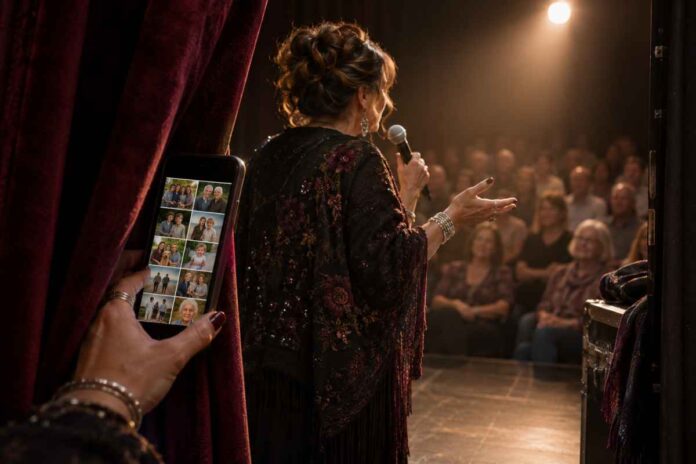
If you buy a ticket to see a psychic medium, keep an eye on who supplies the information. In a typical cold-reading exchange, the person on stage says, “I’m getting a J.”
A woman in the audience says her father was John. The medium gestures towards his chest. She says he died of a heart attack. Then the person with the microphone leans in and says, “He wants you to know he’s proud of you.”
She gave you his name. She gave you his cause of death. You gave her a line you could have delivered to almost anyone in the room. And you had the gall to charge her for it.
What a racket. The performer gets to choose whose answer to follow, glide past a guess that goes nowhere and move on before anyone has time to ask how much of the reading came from the audience.
Then a clip goes online under a title about the moment a medium knew something impossible. Funny how rarely the promotional reel opens with three minutes of wrong guesses.
And when a detail really is specific, ask where else it could have come from. An obituary might list the family, the nickname and the footy club. A public Facebook tribute might mention the red toolbox Dad kept in the shed.
A name on a booking gives anyone with access to it a place to start. That’s called hot reading, and it takes an internet connection and a willingness to look a grieving person in the eye and lie about where you got the information.
If you dug through a woman’s family photos and then told her that her dead husband showed you the shed, what exactly do you expect to be admired for? Finding the post? Keeping a straight face while she cried?
You took a memory she shared because she missed him and sold it back to her under his name.
That’s a con, and you should be ashamed of it.
A million dollars and nobody could collect
There is no independently replicated scientific evidence that psychic mediums can speak to the dead. Psychologists Ciarán O’Keeffe and Richard Wiseman tested professional mediums under controlled conditions and found no support for their claimed ability.
Some studies have reported above-chance accuracy in readings. Even then, the claim these people sell on stage is that the dead are speaking, and an accuracy score can’t tell you who supplied the information.
James Randi’s foundation offered US$1 million to anyone who could demonstrate a paranormal ability under agreed test conditions. More than 1,000 people applied, according to the foundation. The challenge ended without a winner.
The prize is gone. The opportunity to prove the claim is still there. Let independent researchers choose the participants and keep their identities from you.
Do the reading without hearing a word from the recipient. Record every statement, including the duds, and agree on what counts as a hit before anybody sees the results. Then do it again.
You’re asking people to believe you can do something that would upend our understanding of death. Surely you can manage one evening without a booking list and a room full of people finishing your sentences.
How psychic readings are faked
A medium can get a dead person’s nickname exactly right. The question is whether they got it from the dead person, the family in front of them or a Facebook post they read before the show.
Here are the main documented methods and what investigators found in specific cases.
The methods
| Method | How it works |
|---|---|
| Hot reading | Research someone in advance using public profiles, memorial posts, obituaries or information given at booking. Present those facts as messages from the dead. |
| Covert prompting | Someone feeds the performer information through a concealed receiver. The audience hears the performer announce a detail while the person who supplied it stays out of sight. |
| Fishing and reading reactions | Start with an initial, a symptom or a vague image. Follow the sitter’s replies and reactions. The sitter may supply the name and cause of death while the performer takes credit for the match. |
| Shotgunning | Throw several common names, initials or ailments at a crowd. Follow whichever one gets a response. In a packed theatre, “I’m getting a J” has plenty of chances to land. |
| Barnum statements and the rainbow ruse | Use broad statements that feel personal, or cover opposite traits in one line. “You’re usually outgoing, but you sometimes need to shut the world out” fits a lot of people. |
| Turning misses into hits | If the sitter says the name means nothing, widen the search to a middle name, a friend or someone from another branch of the family. The performer keeps changing what would count as a match. |
| Billet reading | Have someone write a private question and seal it in an envelope, then secretly read or swap the note. The answer appears to reveal information the performer had no way of seeing. |
| Physical séance tricks | In darkness, a performer can slip restraints, move furniture or make contact with a sitter. Historical tricks also include prepared slates that make written messages appear as if a spirit produced them. |
Nobody has ever demonstrated & proved that they can speak to the dead
If a psychic medium could reliably ask a dead person where their remains were, police and search teams around the world would have a reason to hire them.
Imagine what that would mean for a family that has spent years searching for someone. Give investigators a precise location they didn’t already know, have them record it before the search, and see whether they find the remains there. Then do it again in another case.
There’s no independently verified case establishing that a medium located a missing person’s remains by speaking to the deceased. A vague mention of water, a road or a patch of bush can be made to fit a discovery after the fact.
The time to give the location is before the search, when the claim can be checked and a wrong answer still counts as wrong.
So if you’re selling tickets on the claim that the dead speak through you, here’s a fair question: Can you tell a search team where to look before they’ve found the body?
That would be worth more to a family than a thousand performances where the person with the microphone says, “I’m getting a name beginning with J.”
The person in tears has nothing to be ashamed of
A father who lost his daughter wants to hear from her. Of course he does.
He’d probably give up a year of his life to hear her call him Dad one more time. Put yourself in his seat for ten seconds and consider the sheer arrogance it takes to announce, in front of a paying crowd, that you know what his daughter wants to tell him.
Then consider what happens when the show ends. He goes home with your words in his head. He might think about them on her birthday. He might hear them every time he replays their last conversation. You get to pack up, check the ticket sales and do it all again in the next town.
That’s what I find so gutless about this business. The biggest claim in the room comes from the person with the least at stake once the lights come up.
And when someone asks for evidence, the audience’s tears get held up as proof. A person crying when they hear their dead child’s name proves they miss their child. How dare you use that to vouch for yourself.
Again, if you’re selling tickets on the promise that the dead will speak through you, prove it before you take another grieving family’s money.