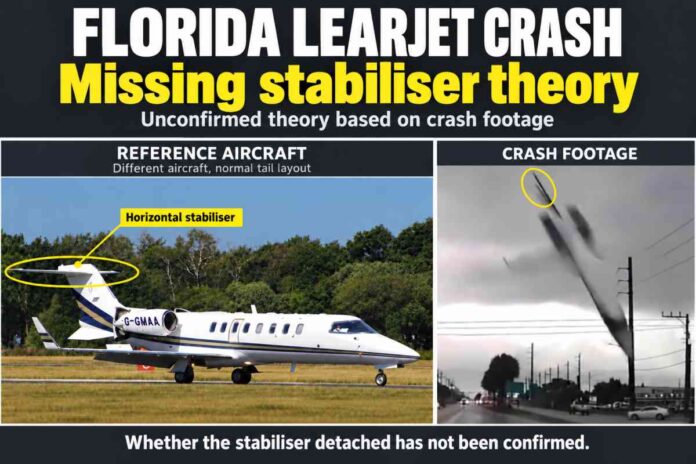
The fatal Learjet 60 crash in Florida has raised a theory about whether its horizontal stabiliser could of separated during flight. If confirmed, investigators would need to determine whether the separation caused the loss of control or resulted from structural limits being exceeded during the descent.
Nine people died when the aircraft plunged into a residential area near Greenacres in Palm Beach County on November 1. Aviation publication AeroTime reported that still frames from dashcam footage appeared to show the horizontal stabiliser missing from the aircraft’s tail.
The images raise a question about whether part of the tail assembly, known as the empennage, separated before impact. However, the blurred footage cannot establish whether the surface was absent, obscured by the viewing angle or difficult to distinguish during the rapid descent.
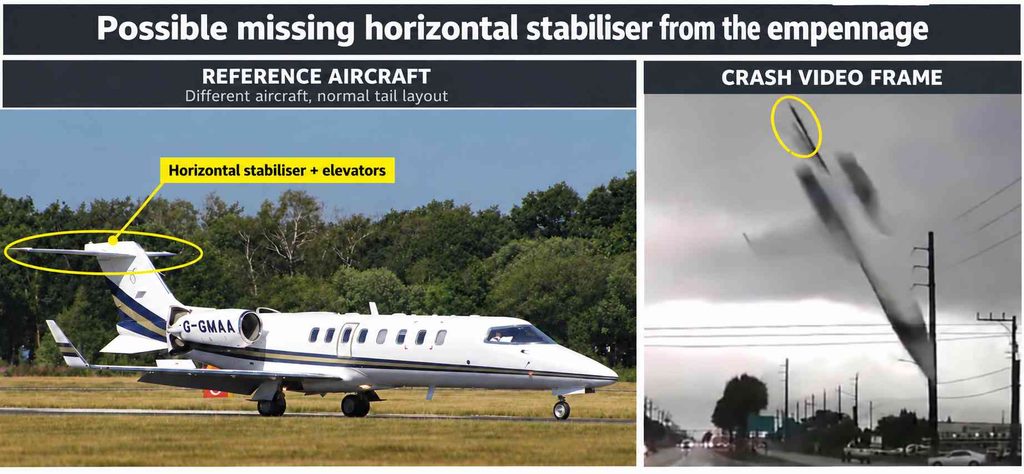
The horizontal stabiliser is the small wing-like surface mounted at the top of the Learjet’s vertical tail. It helps maintain pitch stability, while attached elevators control nose-up and nose-down movement. Loss of that assembly could severely compromise the crew’s ability to control the aircraft.
The Federal Aviation Administration said the aircraft crashed near Cresthaven at approximately 12:50 p.m. local time. It had departed Austin-Bergstrom International Airport in Texas for North Eleuthera Airport in the Bahamas, carrying nine people.
Flightradar24 identified the aircraft as N722BD, a Learjet 60 manufactured in 2004. Tracking records showed it departed Austin at 15:37 UTC, approximately two hours and 12 minutes before the crash.
Near Naples, the jet began descending towards 35,000 feet before briefly climbing and entering a steep right-hand descent. Its reported descent rate exceeded 32,000 feet per minute, with the final altitude transmission placing it at 8,750 feet.
Air traffic control recordings captured by LiveATC.net and reviewed by Flightradar24 showed the crew reporting icing, moderate turbulence and precipitation. The pilots requested a climb to 37,000 feet before subsequently reporting a rapid descent and an overspeed condition.
Those reports provide context for the aircraft’s final movements, but do not establish whether weather, structural damage or another problem caused the loss of control.
The crash left a large crater near homes and passing vehicles, with officials arranging assistance for approximately 600 nearby residents. There were no immediate reports of deaths or injuries on the ground.
The National Transportation Safety Board is leading the investigation with FAA assistance. The missing stabiliser theory remains a visual interpretation of the footage, rather than a confirmed finding about what happened aboard the aircraft.